Friday, June 19, 2009

Memories of Leah Chase, Creole Queen

At 16 years old, my high school best friend Cyrene invited me to New Orleans to visit her older sister in college, I was thrilled. When I came to New Orleans in 1992, I immediately fell in love. Eating beignets, jambalaya, drinking on virgin daiquiris and hearing New Orleans music wherever we went was a treat for two Midwestern girls from Chicago. Yet when Cyrene’s older sister took us to Dooky Chase’s restaurant, I literally lost it. We walked into her restaurant which was surrounded by an art collection that was good enough to exhibit in any major art museum. We toured the restaurant like we were in an art gallery. When it was time for us to be seated, the intoxicating smell of Creole spices from the kitchen floated us to our table where we devoured Leah Chase’s food made with love. Chase, walked over to us with a glowing grin and asked us if we were from New Orleans where we responded that we were from Chicago but Cyrene’s sister was in college in NOLA. We politely remembered our manners and answered with, “Yes Mam, No Mam,” until she gave us some quick advice and walked off to attend the kitchen. I always admired women like Leah Chase. She reminded me a lot of many women I know or read about but particularly one of my idols, the Cuban singer Celia Cruz(now deceased)who likewise created a community filled with love based on her artistic talent and jovial spirit. Leah Chase, a woman of poise who would freely praise or scold to no matter who it is. Chase is truly a New Orleans legend and anyone who ever met her and had the chance to eat her amazing food is forever touched by her beautiful human spirit. So now that I am older, meeting Leah Chase again was like that really good wedding cake frozen in the freezer for 1 year and brought out only to relive the sweet memories again. Likewise, planning for an exhibit in her honor, making sure that the gala event is a huge success, researching and speaking with her is a pleasure for all of us at SoFAB and we all look forward to honoring her on July 2, 2009 at our gala event. So come out New Orleans to celebrate the life and achievements of the Creole Queen, Leah Chase!

Saturday, June 6, 2009

Why I Love this Job!

I could be accused of being obsessed with my work. I am not a detail person, but I cannot find a detail too small that is related to SoFAB. I worry about smudges on the the glass doors and new ideas for partnerships and projects. But the most fun is our programming. This Monday night we have a fabulous program that I am looking forward to sharing with everyone. It is free to members and free with admission to everyone else. Three terrific chefs will be in the museum doing great things for us and serving their food, Chris DeBarr of The Green Goddess Restaurant, Michael Farrell of Le Meritage, and Adolfo Garcia of Rio Mar. That food will be paired with great spirits from Esmeralda Distillery, Obsello Absinthe Verte and Port of Barcelona gin. Join us for our spirited tasting!

This is not a blog full of questions. This is a blog of happiness. I look forward to sharing with everyone, drinking with everyone, eating with everyone, on Monday night. What could be better than that?

Tuesday, June 2, 2009

Treme Culinary Online Exhibit, Coming Soon!

On cold Chicago winter nights, where I am originally from, former New Orleanians in my Southside neighborhood would cook up a pot of gumbo and talk about days gone by in their native land and complain about the quality of seafood in Chicago. To make gumbo, with all its ingredients was hard in itself, coming from a red meat packing industrialized city as Chicago. New Orleanians could only find a fishery way out in the boondocks where they had to buy overpriced, unsatisfying seafood and frozen andouille sausage. But what were their options?, not much. For us Chicagoans, especially those of us who grew up around New Orleanians who fled Storyville and then later Katrina, frozen gumbo in a bag was a treat but to them it was a saddening reality that they were far away from home. We would watch them with envy, wishing that they would take us into their kitchens to teach us their Creole & Cajun food majic while we smelled their warm spicy food as it traveled from door to door.

Some time later, I was accepted as a 3 month intern at the Southern Food & Beverage Museum where I am currently interning while I pursue my Master's degree in Museum Studies at the University of Toronto. I jumped at the offer. So when the director, Liz Williams, gave me one of my first assignments; to help collect and plan an online exhibit of the culinary memories and traditions of the Treme neighborhood, I was thrilled to be able to work with a community that embodies so much history and culinary feats and probably have family in my Southside Chicago neighborhood.

So far, I have reached out to various members of the Treme community but I am hoping that as many as possible communicate with me so I can make sure that their culinary memories become part of what I know will be an amazing online exhibit to celebrate the culinary history of Treme. We do have some previous research done by Bethany Bultman where she researched and interviewed Italians and African-American former residents of Treme. However, we still need more to contribute. So, if you are a former resident or resident of Treme and have any culinary memories, family recipes, and/or would like to be recorded please contact me. Also, if you are a scholar or writer on Treme your participation in this project would be greatly appreciated.

*Tremé is one of the oldest neighborhoods in New Orleans. It was a Mecca for free people of color, Creoles, African-Americans, Sicilians, Caribbeans and Caucasians. It is also the home of the historical Congo Square, Storyville red-light district and Jazz. For more information on the history and culture of the Treme neighborhood, watch a film documentary called Fauborg Tremé: The Untold Story of Black New Orleans which was produced by Dawn Logsdon & Lolis Elie and look for an upcoming HBO series called Treme which will be based on Post-Katrina and the residents who live there.

Thursday, May 28, 2009

Why Food Matters


There has been quite a bit written lately about the way we should eat. This continues the long line of American prescriptions about eating, going back to the nineteenth century concerns about "roughage" and regular bowel movements, the early twentieth century concern for bland food, and our current concerns about everything from cholesterol, sugar, carbs and whatever. We seem to want to force people to eat the way we want them to. It is very puritanical, as we Americans are.

Personally, I am unconcerned about the way we "should" eat. I eat to fuel my body and because it is a pleasure. But I am fascinated by how our puritanical roots inform the way we talk about something that gives us pleasure, that is food. Our language is punitive. There are lots of "doing what is good for you" type phrases. This is why food matters. It allows us to see ourselves today. And by looking at the past, it allows us to see attitudes and culture of the past.

Because everyone eats, food crosses class lines, as well as all of those other lines - gender, race, education, geography, politics, economics, etc. And we can imagine what our forebears went through in their eating, which gives us a tangible way to identify with them.

SoFAB will celebrate its first annivesary next week. We opened the first week in June, 2008. We can celebrate having survived for a year. But we can be secure in realizing that a food museum in not a frivolous enterprise (although it is a fun one), but one that will preserve for the future a special window on our culture.

Monday, May 4, 2009

Dale DeGroff and The Essential Cocktail

I admit it. When I’m at home at night, I frequently watch MSNBC for the latest in news and political commentary. I’m a fan of Chris Matthews, Keith Olberman and Rachel Maddow.

I’m also a fan of mixologist Dale DeGroff who has been making regular appearances on the Rachel Maddow Show. Last week, he was demonstrating mint juleps so that people could make these surprisingly easy cocktails for their Kentucky Derby parties. It was a fun segment.

I don’t know Dale DeGroff personally though he is connected to the Museum of the American Cocktail (he serves as president) and he comes to New Orleans regularly to teach people about the art of making superb drinks.

DeGroff is known in the industry as the “King of Cocktails.” He provides consulting and bar training to beverage companies, hotels, and restaurants around the globe. He was described in a New York Times article as being “single-handedly responsible for what been called the cocktail renaissance.”

DeGroff has produced a book that I really like: The Essential Cocktail, The Art of Mixing Perfect Drinks. It’s a beautiful book, and we sell quite a few of them here in the gift shop of The Southern Food and Beverage Museum.

The Essential Cocktail features drinks that stand out for their flavor, interesting formula, or distinctive technique – martinis, sours, highballs, tropicals, punches, sweets and classics. There are hundreds of recipes along with a compelling history that makes you want to make these drinks.

The book is a visual delight. It is beautifully designed and features fantastic photography.

The Essential Cocktail is one of those books you simply want to hold in your hands. It just has a great feel. Almost like holding a great cocktail.

See all the fun things you learn when you watch those cable news shows.

Whom Can We Trust?


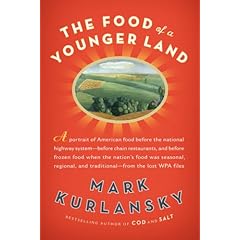
I just finished reading Mark Kurlansky's The Food of a Younger Land. It is terrific book in many ways. It confirms Kurlansky's place as an historian, it serves as a snapshot of a particular time in history, and it calls our attention to an earlier time that involved foodways. We are reminded that we did not just invent the table. In addition the panoramic sweep of the book shows us the entire country, which allows us to see regional trends as well as border influences.

But the book is important to me as I read old cookbooks and read books written by restaurant chefs, the book makes me wonder what can we believe from old cookbooks. Where is the line between story and history? I read a cookbook today with some skepticism - considering the author's agenda and mindful of what may be omitted. But old cookbooks are read as pieces of history. I think that this is probably not wise.

Recently there was a workshop at the Schlesinger Library at Radcliffe Institute for Advanced Study that explored the pitfalls and benefits of relying on cookbooks for historical research. A recent analysis by Rien Fertel of Lafcadio Hearn's book, La Cuisine Creole, revealed plaigarism from other cookbooks and questioned its place in the pantheon of Creole cookbooks. So I am not alone in my questioning.

I know that even when I reveal my warts I want them to be seen in the best light. It is interesting that cookbooks - while appearing to be objective presentations of data - are as biased as a memoir. To me that means that the study of foodways and eating is a fruitful way to learn about the human condition. We wouldn't spin our food stories, if it weren't central to our lives.

Wednesday, April 29, 2009

Getting Carried Away With Betty

Author Betty Fussell kicks off the Southern Food and Beverage Museum’s (SoFAB) Special Lecture Series with “Raising Steaks: The Life and Times of American Beef,” on Saturday, May 2, 2009 at 5 p.m. at the museum. Best known for her book The Story of Corn, winner of the first Jane Grigson Award given by the International Association of Culinary Professionals (IACP) in 1993, Betty Fussell is the author of ten books, ranging from biography to cookbooks, food history and memoir. Her most recent book on American food, Raising Steaks: The Life and Times of American Beef, was published in the fall and has been nominated for a book award by the IACP and the James Beard Foundation.

“We are excited to have a culinary star of Betty’s caliber lecturing at SoFAB. It will be a stimulating event timed to prime the appetite,” says Liz Williams, Director of SoFAB. A frequent speaker at IACP conferences, Betty Fussell was Scholar in Residence in 1999. Her essays on food, travel and the arts have appeared in scholarly journals, popular magazines and newspapers over the past 40 years. She has lectured throughout the country in venues as varied as New York’s Metropolitan Museum of Art and Iowa’s State Fair. A winner of Food Arts’ Silver Spoon Award, she has presented courses and/or workshops in food writing, food history and food preparation at universities, colleges, culinary schools and cooking stores across the United States and in Mexico. Her memoir, My Kitchen Wars, was performed in Hollywood and New York as a one-woman show by actress Dorothy Lyman.

Why a lecture on beef? Fussell may say it best in her book, Raising Steaks, ““Real American men, women and children eat steak because it’s red with blood, blood that pumps flavor, iron, vitality, and sex into flaccid bodies. For women, steak is better than spinach. For men, it’s better than Viagra. With steak, its easy to get carried away.”

SoFAB looks forward to getting carried away with Fussell. As a writer and lecturer, Fussell is both controversial and endearing. “I’ve spent most of my life doing kitchen battle, feeding others and myself, torn between the desire to escape and the impulse to entrench myself further. When social revolutions hustled women out of the kitchen and into the boardroom, I seemed to be caught in flagrante with a potholder in my hand. I knew that the position of women like myself was of strategic importance in the war between the sexes. But if you could stand the heat, did you have to get out of the kitchen?” writes Fussell in Kitchen Wars.