Showing posts with label cookbooks. Show all posts

Monday, May 4, 2009

Whom Can We Trust?


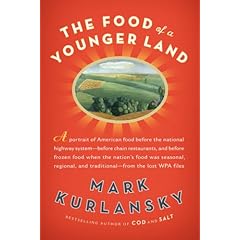
I just finished reading Mark Kurlansky's The Food of a Younger Land. It is terrific book in many ways. It confirms Kurlansky's place as an historian, it serves as a snapshot of a particular time in history, and it calls our attention to an earlier time that involved foodways. We are reminded that we did not just invent the table. In addition the panoramic sweep of the book shows us the entire country, which allows us to see regional trends as well as border influences.

But the book is important to me as I read old cookbooks and read books written by restaurant chefs, the book makes me wonder what can we believe from old cookbooks. Where is the line between story and history? I read a cookbook today with some skepticism - considering the author's agenda and mindful of what may be omitted. But old cookbooks are read as pieces of history. I think that this is probably not wise.

Recently there was a workshop at the Schlesinger Library at Radcliffe Institute for Advanced Study that explored the pitfalls and benefits of relying on cookbooks for historical research. A recent analysis by Rien Fertel of Lafcadio Hearn's book, La Cuisine Creole, revealed plaigarism from other cookbooks and questioned its place in the pantheon of Creole cookbooks. So I am not alone in my questioning.

I know that even when I reveal my warts I want them to be seen in the best light. It is interesting that cookbooks - while appearing to be objective presentations of data - are as biased as a memoir. To me that means that the study of foodways and eating is a fruitful way to learn about the human condition. We wouldn't spin our food stories, if it weren't central to our lives.
Monday, April 20, 2009

Texans -- We Need Your Old Cookbooks

If you have a cookbook with a Texas theme that is getting dusty and moldy on your shelf, let us know. The Southern Food and Beverage Museum is seeking cookbooks from Texas to boost its holdings of books from the Lone Star State.
We estimate that the museum has only 20 to 30 cookbooks pertaining to Texas cuisine and that’s just not enough. Most focus on barbeque or Tex-Mex cuisine.
We also know there are at least 1,000 books that focus on Texas cuisine because the Texas Collection at Baylor University's Carroll Library has at least that many, some going back to the late 19th century.

Texas has a deep and rich culinary history. Each of the five regions of Texas was settled by pioneers from different parts of the United States and Europe. Each had different food heritages. The French, Native Americans, Spanish, Mexicans, and Germans influenced the culture and cuisine of Texas. They adapted their recipes to include local ingredients and cooking facilities.

The museum seeks a variety of cookbooks:
• Restaurant cookbooks and cookbooks created by celebrity chefs;
• Junior League cookbooks;
• Community cookbooks – the inexpensively produced, spiral-bound cookbooks that frequently are created as fundraisers for churches or schools;
• Cookbooks produced by churches, civic groups, public schools, universities, women’s groups or other cultural groups; and
• Specialty cookbooks. For example, a great book that was produced recently is the Texas Judicial Cookbook, a compilation of 59 recipes from residing and former judges and other state and county officials. It’s a tribute to Texas' county courthouses. That’s the kind of book we’re looking for.

Cookbooks are historical documents that provide important information to scholars, researchers, culinary professionals and foodies. Hefty hardbound books or small spiral-bound versions to benefit churches or schools. Filled with recipes from famous chefs or the ladies from around the corner. Seafood, fried food, casseroles, appetizers to desserts. They are all of value to us.

Monday, April 6, 2009

In Praise of Squid

Going through the boxes of donated cookbooks is fun because there is always something unusual that we haven’t seen before.

Recently, something truly unusual and interesting arrived – a cookbook that focuses on squid. The International Squid Cookbook, by Isaac Cronin, is a 94-page paperback devoted exclusively to the preparation and consumption of squid. There are not many cookbooks that focus on squid – in English, probably fewer than ten.

Squid has taken its time in getting to North America. As legend has it, American restaurateurs did not serve squid until someone came up with the idea of using the mollusk’s Italian name – calamari, which refers to any dish that contains squid. (The singular is calamaro.)

Up until then, Americans couldn’t seem to process the idea of eating squid, let alone octopus. Most Americans probably get their information about squid from Jules Verne’s 20,000 Leagues Under the Sea. Even today, most Americans think of squid only as a deep fried appetizer.

The International Squid Cookbook serves as a primer on all things squid: varieties of edible squid; how to buy squid; how to clean squid; how to stuff and cook squid; and even a section on how to deal with tentacles.

Dozens of recipes are broken down by nation of origin as squid is a food that is prepared throughout the world. From Japan, there is squid ball soup. From Indonesia, squid curried in coconut milk. From France, squid and leeks in red wine. There are many recipes from the countries of the Mediterranean.

Obviously, a cookbook devoted to calamari is not something one finds in very many households at this time. They’re hard enough to find in bookstores. That might change because squid might become a more popular food source considering that it grows quickly and many species of fish have been over-harvested.

This is the kind of cookbook that tempts cooks to take a chance, and by doing so, one is rewarded with new and unusual additions to one’s cooking repertoire.

Sunday, May 18, 2008

Laura Appleseed

There is nothing more important than planting a seed. Laura Martin Bacon is planting seeds. And SoFAB is reaping what she has sown.

Many people have been generous about helping SoFAB rebuild our library which was largely turned to pulp by the flood waters after Hurricane Katrina. It was Chris Smith, our Collections Manager, acting on advice from librarian friends, who first began circulating the request for books in library circles. The librarians and libraries, especially the Arkansas State Library, were generous.

Then IACP , through the give-back committee, dispensed the idea that SoFAB would benefit from donations of cookbooks from its members, who were having their annual conference in New Orleans. The idea was refined further as SoFAB promised to inventory the donations and to further dispense those duplicate books to other local libraries and appropriate organization who had also lost their cookbooks after Katrina.

After the IACP conference, which Laura Martin Bacon attended, Laura began writing to key blogs and listserves for writers and readers about SoFAB's need to rebuild its collection. She has planted a seed in the entire United States. From her seeds the blogging world has relayed the message time and time again. I know that if I try to list them that I will leave some out. Newspapers in California have picked up the story further carrying seeds in the wind. Every time I see a box of these books come in, which is almost every day, I know that I have to thank the donor, but I also have to thank Chris, and the IACP give-back committee, and I have to thank that dynamo of passion and good will: Laura.

Thanks to you all soon the citizens of New Orleans - and SoFAB - will have a working, stocked library of cookbooks. For New Orleans is a city of cooks and cookbooks are not only read, but used. We appreciate it.

Saturday, January 19, 2008

Growing the Archive


I was so excited to open a package that came to SoFAB from cookbook author, Sheila E. Ainbinder, for our collection. Sheila wrote a cookbook in celebration of the opening of the Riverwalk in New Orleans in 1986, The Legends of Louisiana Cookbook: The Cuisine of New Orleans and Its Colorful History. The book was privately published in 1987. Later the book was reissued by Simon & Schuster in 1991. The package contained a copy of the original book and a copy of the nationally published book. All of this was great. We cannot have too many Southern cookbooks.

But Sheila sent us more. She sent us the notes from her cookbook, drafts of recipes, letters that she received from contributors of the book, galleys, and old menus. All of these documents flesh out the cookbook, making it not just a finished product, but a work developed and living. We cannot thank Sheila enough. Preserving all of the notes and behind the scenes material creates a treasure trove for researchers in the future. This is one of the important reasons for which SoFAB was created.

To all of the rest of you out there who have written articles, books and other materials about Southern food and drink, please remember to send us your papers. We will preserve and catalog them and make them available to researchers. It will also get them out of your attic, garage or closet.

Thursday, December 6, 2007

Wish List

As we count down until December 31, we are all thinking about what we need to do before the end of the year. We are also looking ahead to those New Year's resolutions. Why not combine those two concepts on behalf of SoFAB. Join or make a donation. Clean off your bookshelves and send us Southern cookbooks and books about the South. (Send them to 1435 Jackson Avenue, New Orleans, LA 70130.) Send us the menus that you have collected at work or at home that you use for take out calls. Mail those menus to us and update your collection for yourself. If you are cleaning out the attic or garage or basement and you find culinary artifacts, send us an email and see if we can use it. Our archives now hold many recipe boxes and scrapbooks full of recipes and clippings. We'd love to have yours or Aunt Sally's.

Most of all we want your stories. Please send them. We are documenting the South. You are part of it.